
Six important First Amendment rulings in New York Times v. Sullivan that AREN'T the actual malice test
There's much, much more to this watershed First Amendment case. Also, a bonus item about my father's small role in the case.

For news organizations and their lawyers, it’s rarely a good thing when the Supreme Court’s landmark 1964 New York Times v. Sullivan actual malice ruling is in the news.
It’s in the news.
In a recent article and a new book, the New York Times’s David Enrich has written about an ongoing campaign to overturn or narrow the decision. Some believe that the Times v. Sullivan actual malice test is in jeopardy. Others think that the Supreme Court’s embrace of the test in 2023 in the Counterman v. Colorado “true threats” case signals that the test is safe for now. There is in any event widespread agreement that the actual malice test paved the way for decades of important reporting on public officials and public figures without fear of defamation liability for good-faith mistakes.
What people may not know is that are at least six other important rulings in Times v. Sullivan that have provided other critical protections for news organizations and anyone who has reported on or spoken about public issues.
Times v. Sullivan is famous for establishing the actual malice fault standard in public official defamation cases. In the Court’s majority opinion, Justice William Brennan wrote that “against the background of a profound national commitment to the principle that debate on public issues should be uninhibited, robust, and wide-open,” imposing liability based on good-faith mistakes would violate the First Amendment because “erroneous statement is inevitable in free debate, and . . . it must be protected if the freedoms of expression are to have the breathing space that they need . . . to survive.” New York Times Co. v. Sullivan, 376 U.S. 254, 271-72 (1964) (quotation omitted).
The Court accordingly held that the First Amendment prohibits public officials from winning defamation lawsuits unless they can prove that defendants published any false statement about them with “actual malice”—“that is, with knowledge that it was false or with reckless disregard of whether it was false or not.” Id. at 280. Later Supreme Court cases extended that requirement to lawsuits brought by public figures, not just public officials, and clarified that “reckless disregard” requires proof that a defendant in fact had serious, subjective doubts about falsity but published anyway.
The story of how the Times v. Sullivan ruling came to be, and how the Times fought the defamation case in the early 1960s, is fascinating. Prof. Samantha Barbas tells it grippingly in the 2023 book Actual Malice.
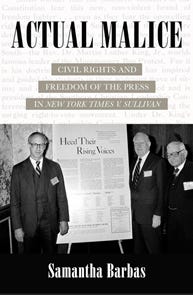
In brief, the case is inextricably intertwined with the mid-century civil rights struggles in the South, and the resulting establishment backlash. Seeking to muzzle national news reporting on segregation and violence against civil rights protesters, Southern public officials began suing for defamation, bringing lawsuits against news organizations and others in state courts before friendly judges and juries.
The case arose out of an advertisement submitted to the Times and approved by the Times’ Advertising Acceptability Department, something that may surprise people who assume that this leading defamation case must have involved New York Times news reporting.
The advertisement, titled “Heed Their Rising Voices,” was placed by the Committee to Defend Martin Luther King and the Struggle for Freedom in the South. It ran in the Times in March 1960. The ad sought to raise money for Dr. King’s legal defense and talked about excesses against civil rights protesters in a number of cities in the South, including Montgomery, Alabama. There were dozens of signers of the ad—including four Black ministers who lived in Alabama: Ralph David Abernathy, S.S. Seay Sr., Fred L. Shuttlesworth, and J.E. Lowery.
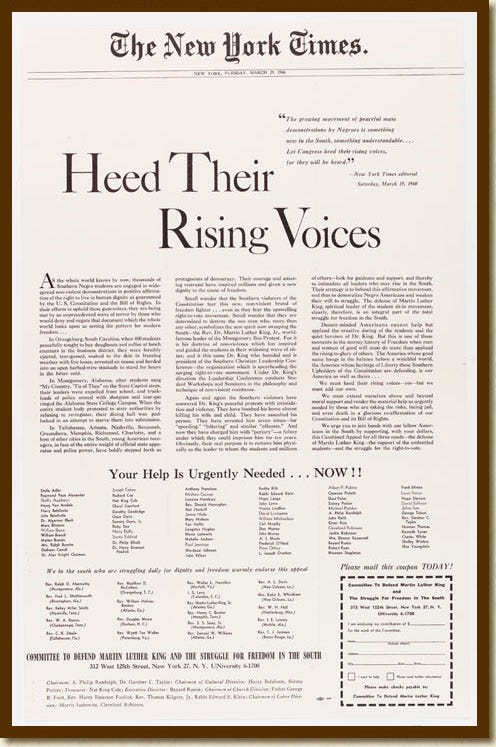
L.B. Sullivan, one of three elected Commissioners of the City of Montgomery, whose duties included supervising the police department, sued for defamation even though he wasn’t personally named or specifically identified in the ad. He alleged that the ad contained factual errors, including that Montgomery police had not literally ringed a college campus and that the campus dining hall had not been padlocked to starve out students. He claimed that statements about the Montgomery police department reflected badly on him because of his responsibilities for supervising the department. He sued the Times for publishing the ad and he sued the four Black ministers who were among those who signed the ad. Since both the plaintiff and some defendants lived in Alabama, the Times was unable to remove the case to federal court.
It turned out that none of the four defendant ministers even knew about the ad before publication—the person responsible for submitting the ad included their names without asking them!
A Montgomery jury found the Times liable for defamation, and the four minister as well despite their lack of awareness of the ad before publication. The jury awarded $500,000 in damages, collectible against all the defendants. This was devasting to the ministers as Sullivan began to collect on the judgment, seizing their cars and imperiling their homes.
Applying the Alabama common law of defamation, the Alabama Supreme Court upheld the judgments. But the U.S. Supreme Court reversed, enforced the First Amendment, and applied the actual malice test to hold that evidence was lacking that any of the defendants were aware of the alleged falsity of statements in the ad before publication.
Since then, the First Amendment rule requiring proof of “actual malice” to provide “breathing space” for inevitable good-faith mistakes has proved critical to the ability of the press and other speakers to report on and discuss important matters of public concern involving public officials or public figures.
But Times v. Sullivan wasn’t limited to this famous holding. The Supreme Court made these six other important rulings in the case that also have provided significant First Amendment protection to reporting and commentary on matters of public concern:
1. A public official can’t sue for defamation for impersonal criticism of a government entity
If you’ve ever wondered why you don’t see officials suing for defamation for allegedly false statements about cities, states, or other units of government, it’s because of a separate holding in Times v. Sullivan. The Court rejected Sullivan’s argument that allegedly false statements about the actions of Montgomery police defamed him personally because it was known that he supervised that department.
One of the required elements of a defamation claim under state law is that the challenged statement must be about the plaintiff specifically, not someone else—in defamation terms, it must be “of and concerning” the plaintiff. The Times v. Sullivan Court held that the First Amendment prevents public officials from suing for defamation over impersonal criticisms of government units for which they’re responsible.
The Court explained: “For good reason, no court of last resort in this country has ever held, or even suggested, that prosecutions for libel on government can have any place in the American system of jurisprudence.” Allowing public officials to claim that statements about government operations for which they are responsible defamed them personally would risk “the possibility that a good-faith critic of government will be penalized for his criticism.” New York Times, 376 U.S. at 291-92 (quotation omitted).
This is an important ruling because imagine how much criticism members of the public direct to towns, municipalities, city departments, and all sorts of government entities, and then imagine if the people in charge of those entities could react by filing defamation lawsuits over such criticism. It would chill citizen speech and engagement.
We saw an example of this earlier this year when a city board of commissioners in Mississippi filed a defamation lawsuit against a local newspaper over an editorial critical of the city for failing to give notice of an important city council meeting. The lawsuit made news because the commissioners convinced the judge to issue an unconstitutional take-down order against the newspaper. But even apart from the prior restraint issue, the lawsuit should never have been brought (and was in fact later dropped) because public officials can’t sue for defamation on behalf of a government entity, thanks to Times v. Sullivan.
2. The First Amendment applies in a civil lawsuit between private parties
The Alabama Supreme Court affirmed the judgment under state defamation law and also rejected the Times’s First Amendment defense, stating that “the First Amendment . . . does not protect libelous publications” and “the Fourteenth Amendment is directed against State action and not private action.” New York Times Co. v. Sullivan, 144 So. 2d 25, 40 (Ala. 1962).
The United States Supreme Court disagreed, ruling that a private party’s use of the court system to impose a burden on a defendant’s speech does indeed qualify as state action that implicates the First Amendment. The Court explained:
What a State may not constitutionally bring about by means of a criminal statute is likewise beyond the reach of its civil law of libel.[] The fear of damage awards under a rule such as that invoked by the Alabama courts here may be markedly more inhibiting than the fear of prosecution under a criminal statute.
New York Times, 376 U.S. at 277.
After this decision, the Supreme Court and lower courts have applied First Amendment protections to all sort of lawsuits between private parties, including to claims for intentional infliction of emotional distress, invasion of privacy, and promissory estoppel. And if not for this state-action ruling, the Times v. Sullivan actual malice standard could only have been applied to prosecutions for criminal defamation and not to the countless private defamation actions that are filed in American courts. So the protection of the actual malice test exists in large part thanks to this separate state-action ruling.
3. Burden of proof: replacing preponderance of the evidence with clear and convincing evidence
The Court also held that the First Amendment interests at issue were so important that the regular burden of proof for plaintiffs in civil lawsuits—known as the preponderance of the evidence standard—wasn’t good enough. As criminal defense lawyers daily explain to juries when emphasizing the importance of the criminal beyond a reasonable doubt standard, the regular civil preponderance of the evidence standard requires a plaintiff to prove their case only by 50% plus a little.
The Court applied a more rigorous standard of proof, known as the “clear and convincing evidence” standard. As first stated by the Times v. Sullivan Court: proof of actual malice must be shown with “the convincing clarity which the constitutional standard demands.” 376 U.S. at 285-86. This is a standard much more demanding than preponderance of the evidence. As the Supreme Court explained in a later case, it requires that “the ultimate factfinder [have] an abiding conviction that the truth of [the] factual contentions [is] highly probable.” Colorado v. New Mexico, 467 U.S. 310, 316 (1984) (quotation omitted).
And that heightened burden of proof is a critical reason why the actual malice test is considered so difficult for public official and public figure plaintiffs to satisfy at earlier stages of a case, like summary judgment.
One Third Circuit judge demonstrated why the difference between the two burdens of proof could itself decide a case. Affirming summary judgment for news magazine defendants in an actual malice case, the judge concluded that the plaintiff’s case against the defendants “includes some evidence of actual malice, but not the clear and convincing evidence needed to survive summary judgment.” Tucker v. Fischbein, 237 F.3d 275, 285 (3d Cir. 2001) (emphasis added). That judge later become much more well known when he was elevated to the Supreme Court: Samuel Alito.
4. Appellate review: replacing deferential review with independent appellate review
But wait, there’s more!
Times v. Sullivan also introduced the concept of independent of appellate review of district court judgments in actual malice cases. Ordinarily, an appellate court’s review of the facts found in a trial court by a judge or jury is highly deferential, essentially accepting all findings that the factfinder reasonably could have reached. The Court determined that protecting First Amendment interests required more active appellate involvement, known as independent appellate review The Court said that “in proper cases,” like this one, an appellate court must review the evidence “to make certain that th[e] principles” it laid down elsewhere in the opinion “have been constitutionally applied.” 376 U.S. at 285.
In such cases, “the rule is that we examine for ourselves the statements in issue and the circumstances under which they were made to see” whether they are protected by the First Amendment. In doing so, the Court “must make an independent examination of the whole record, so as to assure ourselves that the judgment does not constitute a forbidden intrusion on the field of free expression.” Id. (quotation omitted; emphasis added). This means that, to protect defendants’ First Amendment rights, an appellate court may reject certain factual findings that in other types of cases would be beyond question.
Considered together, the strict actual malice test, the clear and convincing evidence standard, and the protection of independent appellate review, all serve to ensure that defamation defendants in actual malice cases benefit from close court attention to protect First Amendment rights at every stage. And all of these protections come from Times v. Sullivan.
5. Requiring proof of the defendant’s state of mind at the time of publication, not later
Another important ruling in Times v. Sullivan is the timing of relevant evidence of a defendant’s state of mind regarding the truth or falsity of what it published. One could imagine a rule stating that if a defendant learns, after it has already published an article, book, etc., of information undermining its accuracy, then such after-acquired information could impose a duty to retract or correct the publication. The Supreme Court said no: the relevant time for assessing state of mind as to malice is “at the time of the publication.” Thus, the Times’ later “failure to retract upon respondent’s demand” was “not adequate evidence of malice for constitutional purposes.” 376 U.S. at 286.
This focus on a defendant’s state of mind at the time of publication underscores that the actual malice test is subjective, requiring proof of what the defendant knew when it published. This ruling thus furthers the goal of the actual malice test by helping ensure that a defendant cannot be held liable in defamation for a good-faith mistake at the time of publication and has benefited countless defendants in the decades that followed.
6. Limiting state of mind evidence to the individuals within an organization actually responsible for the challenged publication
Finally, and relatedly, the Times v. Sullivan Court held that when a company or other entity is a defamation defendant, a plaintiff may not aggregate state of mind evidence by trying to show that someone somewhere in the organization had information that could prove the falsity of what was published. Instead, the only people whose state of mind may be examined are the employees who were actually responsible for publishing the challenged statements.
This was in fact an issue critical to the Times v. Sullivan Court’s reversal of the Alabama judgment. This is because there was “evidence that the Times published the advertisement without checking its accuracy against the news stories in the Times’ own files.” 376 U.S. at 287. The Court said that evidence wasn’t relevant:
The mere presence of the stories in the files does not . . . establish that the Times “knew” the advertisement was false, since the state of mind required for actual malice would have to be brought home to the person in the Times’ organization having responsibility for the publication of the advertisement.
Id. Thus, even though the Times journalists may have had information disproving challenged statements in the advertisement, the only relevant inquiry was what the people in the advertising department who handled the advertisement knew.
This too has been a critical precedent in the time since Times v. Sullivan. Prohibiting plaintiffs from aggregating the knowledge in an organization has allowed defendants to avoid expensive and burdensome discovery and limit the litigation to the often small group of people actually responsible for publication.
* * *
Each of these six rulings has been important in successfully defending a number of defamation lawsuits, they’re all in addition to the actual malice test, and they all come from Times v. Sullivan.
Bonus 1: My father’s small role in New York Times v. Sullivan
I first read the Times v. Sullivan opinion in law school in 1989. I had to look it up to cite check a paper, which back then meant going to the library and pulling out the hardback volume 376 of U.S. Reports. One thing unusual about this version of the opinion is that it is accompanied by a poster-size copy of the March 1960 “Heed Their Rising Voices” ad, folded a few times to fit in the book. I scanned the ad and noticed that among the dozens of signers—including luminaries like Eleanor Roosevelt and Sidney Poitier—was Nat Hentoff, my father.
In 1960 my father had been transitioning from almost exclusively writing about jazz. By then he was writing in The Village Voice among other places about civil rights, civil liberties, and politics. He later covered Dr. Martin Luther King, Jr.’s March on Washington. So it wasn’t too surprising to me that he was one of the signers.
I asked him about it and, thinking back 30 years at the time, he said he really didn’t remember much about the ad and wasn’t sure that he’d ever even been asked ahead of time if his name could be added. That made some sense, since it was established in the record of the case that the four Alabama ministers definitely had not been asked before their names had been used.
I didn’t think too much about it again until I read Professor Barbas’s book, which came out several years after my father died. It had a brief vignette involving him:
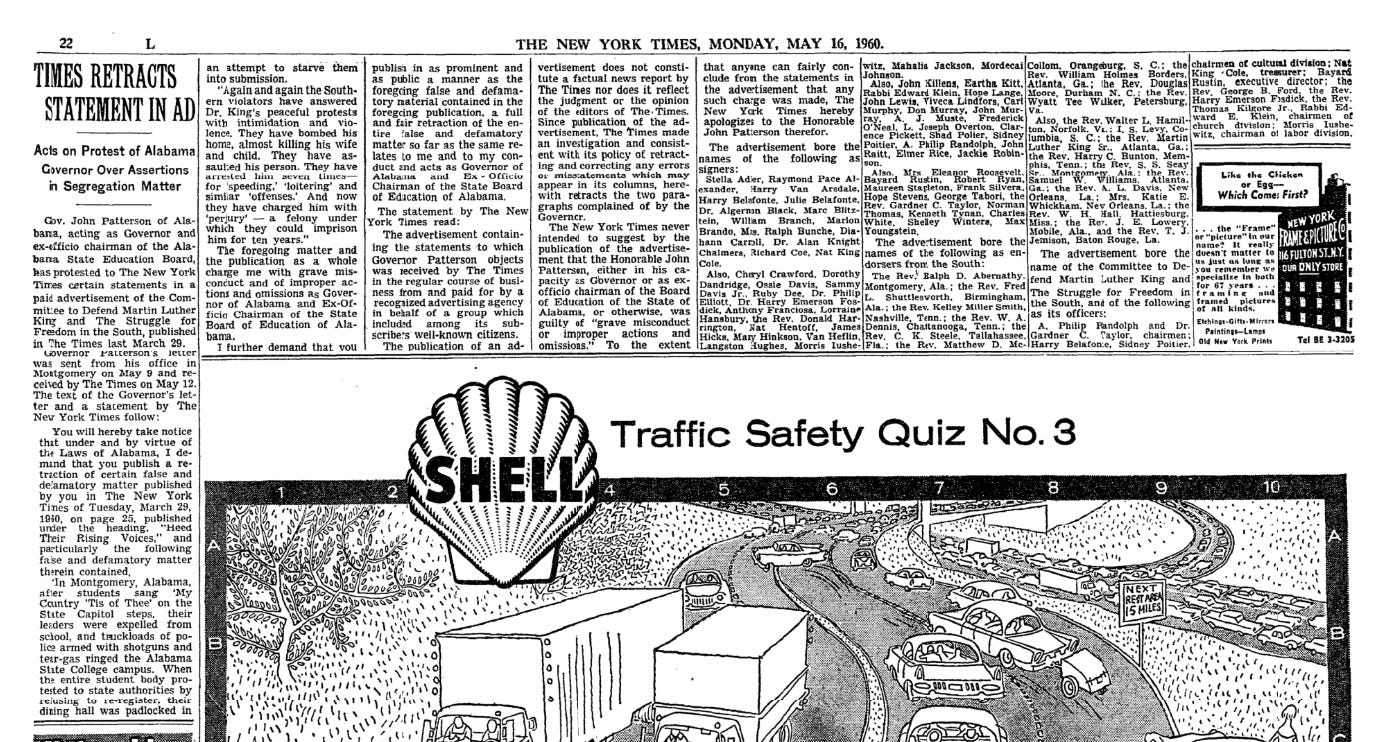
Although Commissioner L.B. Sullivan filed the first defamation lawsuit over the Times’ publication of the “Heed Their Rising Voices” ad, it wasn’t the only lawsuit by an Alabama public official. Later, Alabama Governor John Patterson also sued over the ad. As Professor Barbas describes in the book, although the Times had not issued a retraction of the ad in response to the original L.B. Sullivan’s lawsuit, it decided to retract part of the ad in response to Governor Patterson’s later lawsuit. (There were liability and risk-avoidance reasons for doing so in response to the later suit.)
The Times ran the retraction on page 22 of its May 16, 1960 edition. The retraction said that the Times had never intended to allege that the governor—who also was not named or identified in the ad—had engaged in misconduct. And then the retraction went on to mention the names of every person listed as a signer of the ad, including my father:
I learned from the Actual Malice book that this caused my father to respond in a June 1, 1960 column in The Village Voice titled “The Soft Decay of the New York Times.” This concluding paragraph showed that he strongly objected:
In an extraordinary – and shameful – display of cowardice, the Times retracted the two paragraphs without explanation as to the specific facts therein it had presumably found to be untrue. The Times, underlying the fact that it had nothing to do with the ad, published the list of signers, among them myself. Is the Times saying I’m a liar? I’m mildly tempted to sue the Times, for defamation of character, but the Times has done itself such serious damage by its pusillanimous yielding to the Governor of Alabama that anything any of us tried to add would be superfluous…
So my father hadn’t remembered that when I spoke with him 30 years later, but thanks to Professor Barbas’s book I was able to learn that when the Times retracted a part of the ad my father had criticized it for doing so.
Bonus 2:
Here’s a photo of a bald eagle that I took earlier this month in Dyke Marsh Wildlife Preserve in Alexandria, Virginia:

Tom:
Your observations about Sullivan (and your comments today on MLRC) are important. Sullivan has become an "Actual Malice" buzzword that obscures all that it did and said. We reduce many foundational cases to buzzwords. We don't read them any more. But Sullivan is rich and deep and it has given us much more than people fully recognize. Thanks for pulling this together! A nice read too. -David Korzenik